Northern Lights and Weather in Tromsø: What Are Your Real Chances?
One of the most common questions we receive from guests booking a Northern Lights Tour in Tromsø is: “What are my chances of actually seeing the Aurora Borealis?”
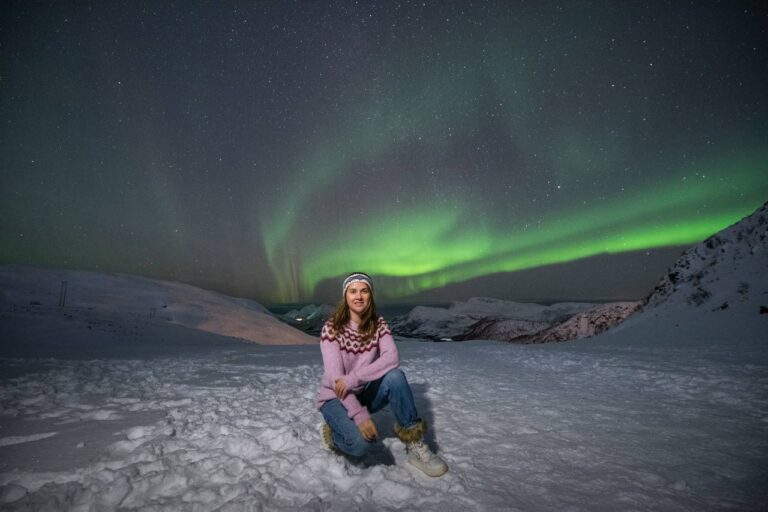
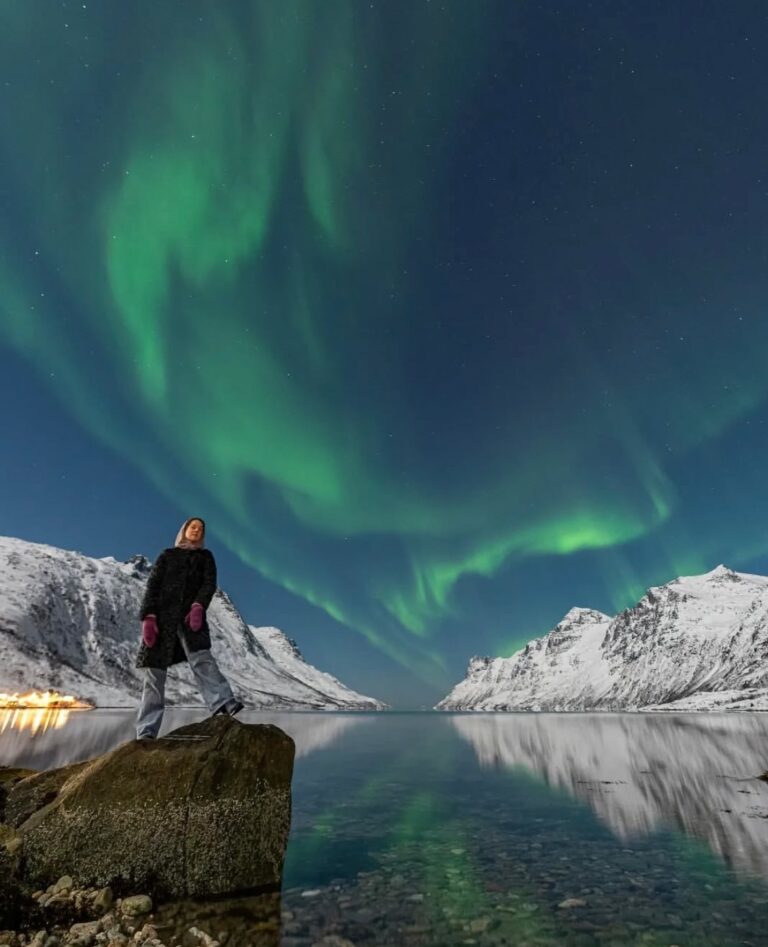
The answer depends largely on weather conditions, cloud cover, solar activity, and the flexibility of your Northern Lights tour. Fortunately, Tromsø is one of the best places in the world to see the Northern Lights, and experienced guides can often improve your chances by driving to areas with clearer skies.
When it comes to the Northern Lights, it’s important to remember one thing: weather is a forecast, not a guarantee. It can change quickly and, especially in this region, it can be inaccurate even just a few hours ahead. That’s why it’s best to join the tour with excitement—but also with realistic expectations.
| Weather Condition | Can You See Northern Lights? |
|---|---|
| Clear Sky | Excellent |
| Partly Cloudy | Often Possible |
| Thin Clouds | Sometimes Visible |
| Heavy Clouds | Usually Not Visible |
| Rain or Snow Storm | Very Difficult |
Why the Weather Forecast in Tromsø Can Be Misleading
Tromsø is considered one of the world’s top destinations for Aurora viewing thanks to its location under the Aurora Oval and easy access to different weather zones. Learn more in our article about why Tromsø is one of the best places to see the Northern Lights.
Many visitors check the weather forecast for Tromsø and assume that a cloudy prediction means they have no chance of seeing the Northern Lights. In reality, Arctic weather is much more complex.
Tromsø is surrounded by mountains, fjords, islands, and changing weather systems. Conditions can vary dramatically within a relatively short distance. While the city may be completely covered by clouds, clear skies can often be found just 30 to 60 minutes away.
This is one of the main reasons why experienced Northern Lights guides constantly monitor multiple weather models rather than relying on a single forecast. Before every tour, guides analyze cloud cover maps, wind patterns, satellite images, and local weather conditions to identify the areas with the highest chances of clear skies.
Can You See the Northern Lights From Tromsø City?
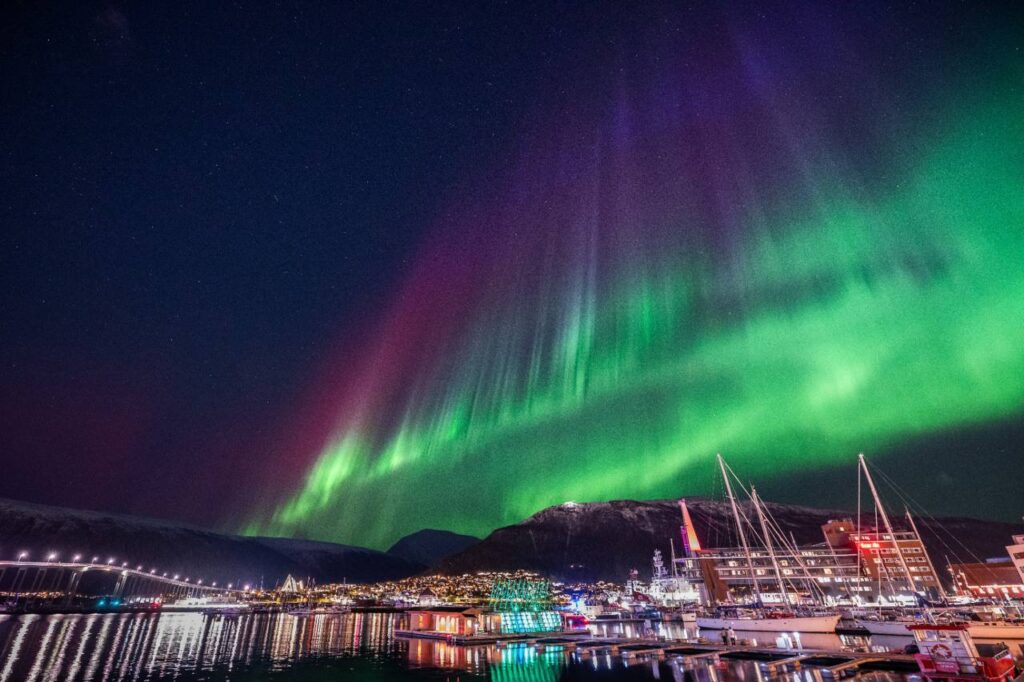
While it is sometimes possible to see the Northern Lights directly from Tromsø city center, city lights and local cloud cover can reduce visibility.
Joining a guided Northern Lights Tour allows you to travel away from light pollution and toward areas with better weather conditions, significantly increasing your chances of seeing the Aurora.
We cover this in detail in our guide about seeing the Northern Lights from Tromsø city centre.
Why We Sometimes Drive to Finland?
On some evenings, finding good conditions may require only a short drive from Tromsø. On other nights, guides may travel much further inland, sometimes even towards the Finnish or Swedish border, where the weather is often drier and skies can be significantly clearer.
For this reason, the weather forecast for Tromsø city alone does not determine your chances of seeing the Aurora. What matters most is the ability to move to the best available location and adapt to changing conditions throughout the evening.
This flexibility is one of the biggest advantages of joining a Northern Lights chase tour, especially during periods of unstable weather.
Looking for the best chance to see the Aurora? Explore our Small Group Northern Lights Tour in Tromsø, where guides actively chase clear skies across Northern Norway.
Tromsø: microclimates and two main climate zones
The Tromsø region is well known for its many microclimates. This means the weather can be completely different just a few kilometers apart. In particular, there are two main climate areas:
- Coastal area (more humid, cloudier, and more changeable)
- Inland area (often drier, colder, and with better chances of clear skies)
It often happens that when the coast is cloudy, the inland is clearer—and vice versa. This is one of the main reasons why checking the weather “in Tromsø city” is often not useful: tours don’t stay in town, they move to wherever conditions are best, and sometimes the weather outside Tromsø is the opposite of what the forecast shows for the city.
Why no tour can guarantee the Northern Lights?
No serious operator can promise an aurora sighting, because the Northern Lights are a natural phenomenon. They depend on solar activity and its interaction with Earth’s atmosphere, and they can strengthen or fade unpredictably. On top of that, clouds move and change fast—so a “clear sky” forecast doesn’t automatically mean you will see aurora.
It’s important to know that:
- Even under clear skies, you might not see the aurora if the activity is weak or absent.
- In stormy weather (wind, snow, heavy clouds), there can be sudden clear breaks, and the aurora can appear exactly during those moments.
In other words: there is no absolute rule. The aurora can surprise you when you least expect it, or it may not show up even with seemingly perfect conditions.
What we do during the tour?
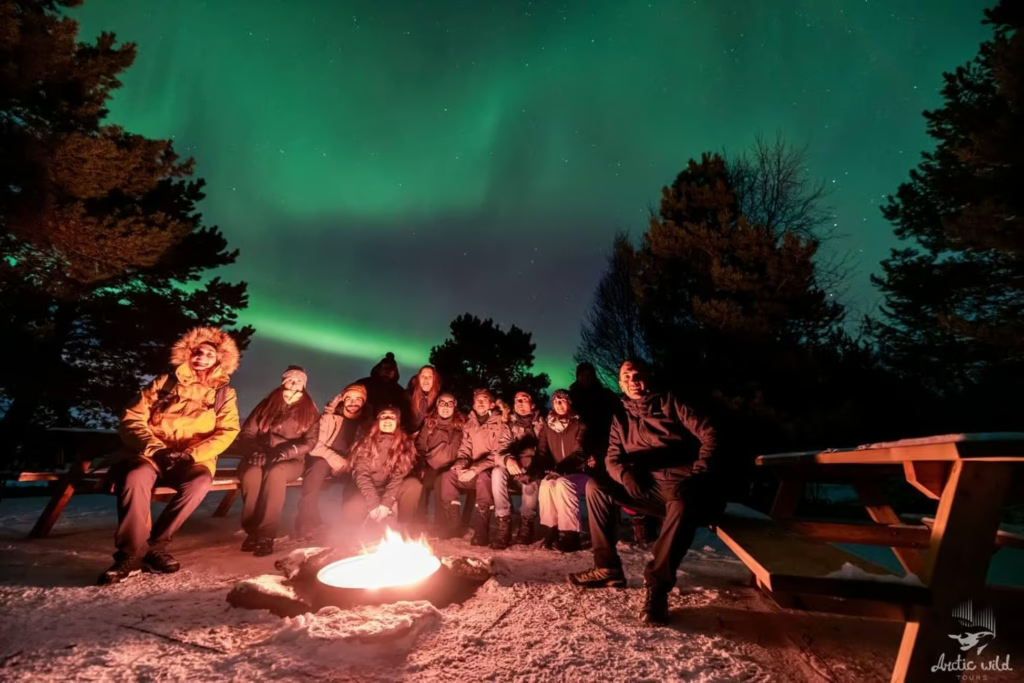
Our goal is simple: to find the clearest sky possible. To do that, we move based on real-time conditions, not just weather apps, covering a wide area from the coast to inland regions and, if needed, all the way into Finland.
Thanks to this strategy, we achieve about a 90% success rate on the nights we operate—meaning that most evenings we manage to find an area with suitable sky conditions. However, even with the best planning, there are nights when seeing the aurora is not possible.
If we don’t see it: why it can happen?
A missed sighting usually comes down to two main factors, both often unpredictable:
- Weather not matching the forecast (persistent cloud cover, large cloudy areas, sudden changes)
- No aurora present or aurora too weak at the time and place we are watching
Sometimes both happen together, and despite our best efforts, the result can’t be guaranteed.
The best way to enjoy the experience
The best advice is: stay positive, but realistic. The Northern Lights are one of the most breathtaking natural shows on Earth, but precisely because they are natural, they can’t be controlled. We will do everything we can to chase the best conditions and drive where needed—but nature always has the final say.
Aurora forecasting: what it really means (and why apps can be misleading)
Northern Lights activity can only be predicted with decent accuracy about one hour in advance. That’s because a NASA spacecraft (DSCOVR) measures the incoming solar wind and particles heading toward Earth roughly 60 minutes before they reach us. In practice, this means you can’t reliably decide days in advance which evening will be “the best” for aurora—conditions can change quickly, and the most useful information often comes very close to tour time. For the same reason, we don’t recommend relying on aurora apps: they are approximate, often based on daily averages and broad models that may be relevant somewhere else (and at a different time of day), but not necessarily for our location in the evening. Finally, Tromsø sits right under the Auroral Oval, which makes this area ideal for spotting strong auroras even during low solar activity, as long as the sky is clear.
What Matters More: Weather or KP Index?
Weather is more important than KP.
A strong KP 6 storm behind thick clouds is invisible. A KP 2 display under clear skies can still create a memorable Northern Lights experience.
Best Weather Forecast APPS / Websites for Northern Lights in Tromsø
While weather forecasts can help, local experience and flexibility often make the biggest difference. Our Small Group Northern Lights Tour is designed to maximize your chances by actively searching for the clearest skies available on each evening.
Ready to Chase Clear Skies?
Join our Small Group Northern Lights Tour and let experienced guides search for the best weather conditions across Northern Norway. 👉 Book Your Northern Lights Tour.
The Northern Lights season in Tromsø typically runs from September to March, when the nights are dark enough for Aurora viewing. If you’re planning your trip around the Aurora season, you may also want to read our guide on the best time to see the Northern Lights in Tromsø, where we compare each month from September to March and explain what conditions to expect throughout the season.
Frequently Asked Questions About Weather and Northern Lights in Tromsø
Can you see Northern Lights through clouds?
Usually, no. The Northern Lights occur high above the clouds, so thick cloud cover can block the view completely. However, if the clouds are thin or broken, the Aurora may still be visible through gaps in the sky.
Does snow affect Northern Lights visibility?
Snow itself does not stop the Northern Lights from appearing, but heavy snowfall usually means there are clouds above you. In that case, visibility can be limited. Light snow with clear patches in the sky may still allow you to see the Aurora.
What weather app is best for Northern Lights in Tromsø?
Useful weather tools include Yr.no, Windy, Ventusky, and satellite cloud maps. However, no single app is perfect. Northern Lights guides usually compare several forecasts and real-time cloud conditions before choosing the best route.
Can you see Aurora when it is snowing?
It is difficult to see the Aurora during heavy snow because the sky is usually covered by clouds. But Arctic weather changes quickly, and clear openings can appear later in the evening or in nearby areas away from Tromsø.
Why do Northern Lights tours drive long distances?
Northern Lights tours often drive long distances to escape cloud cover and find clearer skies. On some nights, the best conditions may be close to Tromsø, while on other nights guides may drive inland or toward the Finnish or Swedish border.
Is a cloudy forecast always bad for Northern Lights?
Not always. A cloudy forecast for Tromsø city does not mean the entire region is cloudy. Weather can be very different along the coast, in the fjords, or inland. This is why mobility is one of the biggest advantages of a Northern Lights chase.
What percentage chance do I have of seeing the Northern Lights in Tromsø?
There is no fixed percentage because Northern Lights visibility depends on several factors: solar activity, darkness, cloud cover, and local weather conditions. Tromsø is one of the best places in the world for Aurora viewing, but sightings can never be guaranteed.
Does KP index matter in Tromsø?
Yes, but not as much as many visitors think. Tromsø is located under the Aurora oval, so Northern Lights can often be visible even with a low KP index. Clear skies are usually more important than a high KP number.
Can Northern Lights appear during bad weather?
The Aurora can still be active during bad weather, but clouds, snow, or rain may prevent you from seeing it. The lights may be happening above the clouds even if they are not visible from the ground.
Is Tromsø too cloudy for Aurora viewing?
Tromsø can have cloudy and changeable weather, especially because it is located near the coast. However, the region also has many microclimates. By driving away from the city, it is often possible to find clearer skies in another area.
What matters more: weather or Aurora forecast?
For actually seeing the Northern Lights, weather is often more important. A strong Aurora behind thick clouds cannot be seen, while a weaker Aurora under clear skies can still create a beautiful experience.
Can the weather change during a Northern Lights tour?
Yes. Weather around Tromsø can change very quickly. Conditions may shift within 30 to 60 minutes, which is why guides continue checking forecasts and cloud movements throughout the evening.
Why can the sky be cloudy in Tromsø but clear nearby?
Tromsø is surrounded by mountains, fjords, islands, and coastal weather systems. These create local microclimates, meaning one area can be cloudy while another area nearby has clear skies.
Is rain bad for seeing the Northern Lights?
Rain usually means there are clouds above you, so it can make Aurora viewing difficult. However, if the weather improves later in the evening or guides can find a clearer location, there may still be a chance.
Should I cancel my Northern Lights tour if the forecast looks cloudy?
Not necessarily. A cloudy forecast in Tromsø city does not always reflect conditions across the wider region. It is better to rely on local guides, who check multiple forecasts and search for the best available skies on the night of the tour.